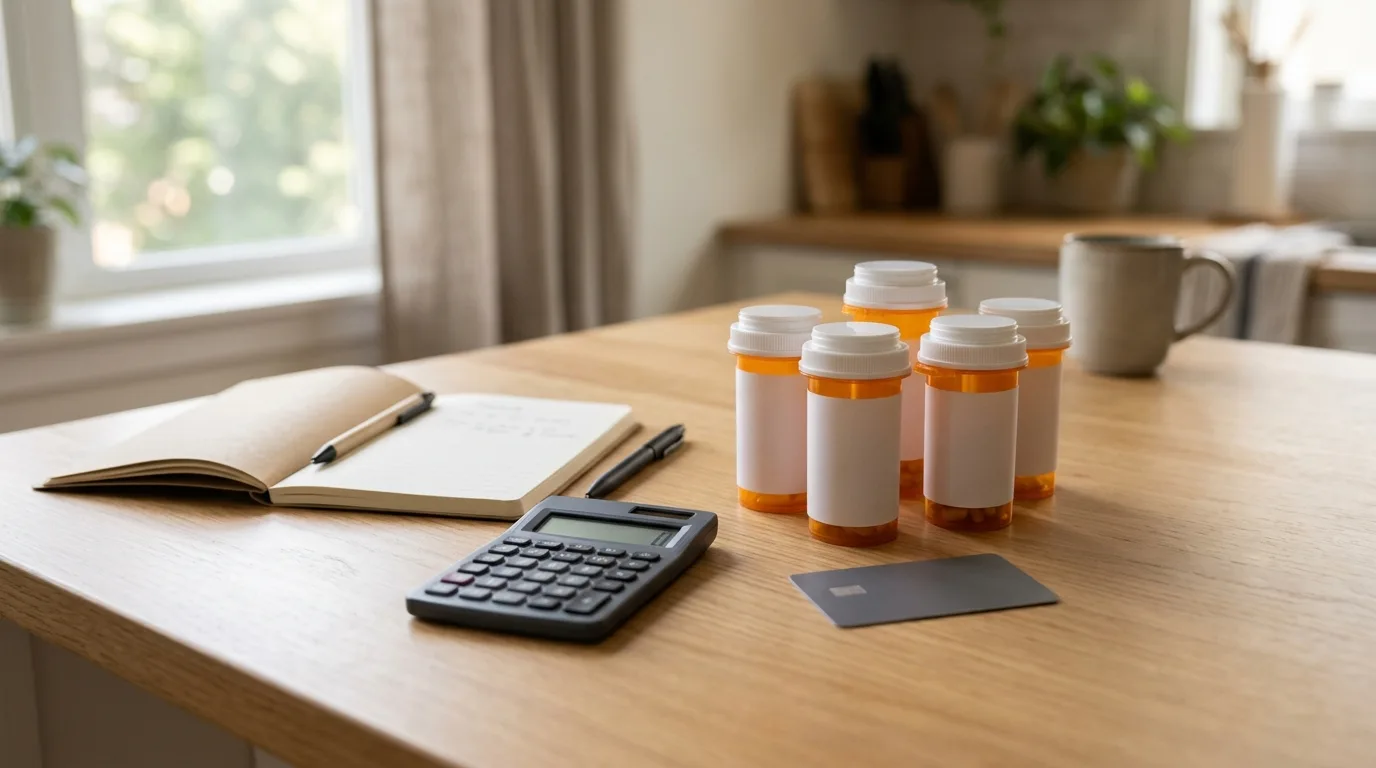
For high prescription costs, a flat-rate cash back card with no cap on what you earn is usually the safest pick, because many drugstore bonus categories have spending limits and don't always count every pharmacy. The reason is simple: when you spend far more than most people at the pharmacy, a capped bonus runs out fast, and a card that pays the same rate on everything keeps paying all year. Prescription spending has been climbing for many households, with the Consumer Expenditure Survey showing a 21.7% increase from 2023 to 2024.[1] This article walks through how pharmacy purchases get coded, why Costco and Walmart pharmacies can behave differently, how reward caps work, and whether a new card is worth opening at all.
Why do capped drugstore bonuses often lose for big prescription bills?
Many cash back cards advertise a higher rate at drugstores. That sounds perfect if you spend a lot on prescriptions. The catch is that bonus categories often come with a cap, meaning the higher rate only applies up to a certain amount of spending in a month, quarter, or year. After that, you earn a much lower rate. Compare current cash back offers.
Here's a simple example. Say you spend $400 a month on prescriptions, or $4,800 a year. A card with 3% back at drugstores, capped at $1,500 a quarter, would pay 3% on all of it, since $1,200 a quarter is under the cap. But if your family spends $700 a month, that's $2,100 a quarter. The extra $600 would earn only the basic rate, maybe 1%. And that's the best case, where the pharmacy codes as a drugstore at all.
A flat 2% card with no cap pays 2% on every dollar. On $4,800 a year, that's $96. On $8,400 a year, it's $168. It's less exciting on paper, but it's predictable and it never runs out.
Multiply your monthly pharmacy spending by the length of the cap period (a month, quarter, or year). If the total is above the cap, the bonus rate stops partway through and you should compare it against a flat-rate card.
Already know what you want? Check out top cash back offers available now, and compare how each handles pharmacy purchases and reward caps.
Learn MoreHow does pharmacy coding decide whether you earn a bonus?
When you pay, the merchant is assigned a category code. Your card issuer uses that code to decide whether a purchase counts as a drugstore, grocery, warehouse club, or something else. You don't control this, and the issuer doesn't look at what's in the bag.
That means a prescription filled at a standalone pharmacy usually codes as a drugstore. But a prescription filled at the pharmacy counter inside a grocery store, warehouse club, or big-box store may be coded as the store's main business instead. Sometimes it's coded as a pharmacy, sometimes it isn't, and the rules can differ by card.
Because of this, don't assume a drugstore bonus will apply to your prescriptions just because the pharmacy is part of a big chain. The bonus terms on the card's page are the place to check, along with a look at your own past card statements to see how those pharmacy charges were categorized.
- Check the category your current card assigned to your last few pharmacy charges.
- Read the card's bonus category terms for how it treats pharmacies inside other stores.
- If the coding is unclear, treat the bonus as a maybe and plan around the flat rate.
Looking at how your pharmacy charges show up on your statement tells you how they are coded.
Does it matter if you fill prescriptions at Costco or Walmart?
Yes, in two ways: how the purchase codes and which cards the store accepts.
Warehouse clubs often accept only certain payment networks at the register, so a card you'd like to use might not work there at all. Check what the store takes before picking a card around it. Some people also pay for prescriptions at a club pharmacy with a card tied to that club, but the rewards may be lower than a good flat-rate card, so compare before assuming it's best.
Big-box stores add another wrinkle. Their pharmacy counters may code as general merchandise or grocery, depending on the store and the card. And some cards exclude superstore purchases from their grocery bonus. Pay attention to the fine print on both the store side and the card side.
The simplest approach is to pick a card that earns the same rate everywhere and works at the pharmacy you actually use. If you then want to chase a bonus, use it as an extra rather than the foundation of your plan.
Cash Back Offers
Ready to compare cash back cards?
| Card type | How it earns | Main upside | Main watch-out |
|---|---|---|---|
| Flat-rate cash back | Same rate on every purchase | No cap, no coding worries | Lower rate than a perfect bonus |
| Drugstore bonus card | Higher rate at drugstores | Can pay more on small spending | Caps and coding limits |
| Grocery or superstore card | Bonus at grocery stores | May help if the pharmacy codes as grocery | Superstores are often excluded |
| Store or club card | Rewards tied to one retailer | Works at that retailer | May earn less elsewhere |
What kind of card makes the most sense?
Start with what matters most for large recurring spending: no cap, a rate you can count on, and no annual fee unless the extra rewards clearly cover it. These cards are generally recommended for good to excellent credit.
If you also spend a lot on groceries or gas, a flat-rate card keeps things simple because everything earns the same. A card with a high bonus rate plus a flat rate elsewhere can work if your pharmacy codes correctly and your spending stays under the cap. If you're not sure of either, flat-rate wins.
A health-care angle is worth keeping in mind too. If you're on Medicare Part D, your out-of-pocket costs for covered prescription drugs are limited to $2,000 per year starting in 2025.[2] That means your spending may be lower than you expect, which makes a cap less of a worry. On the other hand, if you aren't on Part D or you buy uncovered drugs, the cap math above matters more.
Whichever card you choose, only charge what you can pay off in full each month. Cash back is small compared to credit card interest, and one month of carried balance can wipe out a year of rewards.
Is it worth opening a new card for prescriptions?
Often the answer comes down to the gap between what you earn now and what you could earn. If your current card pays 1.5% or 2% flat and works at your pharmacy, a new card may add very little. On $6,000 a year, the difference between 2% and 3% is $60, and that's before any annual fee.
A new card makes more sense if your current card earns almost nothing, if it doesn't work at the pharmacy you use, or if you have a card that doesn't pay on pharmacy purchases at all. Opening a new account can also temporarily lower your credit score a bit, and it adds one more account to keep track of.
Also consider whether the card's other perks fit your life. If you'd use them anyway, they can tip the decision. If not, ignore them and focus on the rate and the cap.
Use the table below to compare the common options at a glance.
If prescriptions are a big expense, keep them on one card. Statements make a handy record for budgeting, and some people also use them when sorting through medical expenses at tax time.
Compare Current Offers
Compare cash back cards for everyday spending
See current offers and check the reward caps, the pharmacy rules, and the annual fee before you decide.

Comparing a reward cap against your yearly spending takes only a few minutes with a calculator.
Learn More About Top OffersFrequently Asked Questions
What cash back card is best for high prescription costs?
Do prescriptions always earn drugstore bonus cash back?
Is it worth opening a new card just for prescriptions?
Can I use a health savings account and a credit card together?
What happens to my cash back if I hit a reward cap?
Should I carry a balance if I'm short on cash for prescriptions?
The Bottom Line
If your prescription costs are high, an uncapped flat-rate cash back card with no annual fee is the safest choice for most people. It pays on every dollar and doesn't depend on how your pharmacy is coded.
Before you open anything new, check how your pharmacy charges are categorized now, do the cap math on your own spending, and make sure the card works where you fill prescriptions. If your current card already does that, you may not need a new one.