
Quick math: the average household spends around $741 a year on pets.[2] A flat 1% back on a generic card would return only a small amount, while a higher earn rate on a well-chosen rewards card could return more over time. The right card won't pay your vet bill for you, but it can help offset a real chunk of it over time. The key question is whether to chase a high flat rate or a card that supercharges specific spending categories — and the answer depends on where your pet dollars actually go.
Key Takeaways
- A flat-rate cash back card is the simplest choice and earns consistently across every pet expense — food, vet, boarding, and supplies.
- Category-bonus cards can earn more if most of your pet spending falls cleanly into one or two elevated categories, but require more tracking.
- A 0% intro APR card is worth considering only if you have a large, planned vet expense coming up — carrying a balance at a high ongoing rate will wipe out any rewards earned.
Where Does Your Pet Money Actually Go?
Before picking a card, you need to know your spend breakdown. According to BLS data, vet services account for about 35% of pet spending, food around 33%, supplies and medicine 23%, and care services like boarding and grooming the remaining 9%.[3] That spread matters a lot for card strategy. Compare current cash back card offers.
Take a household spending $1,500 a year on a pet — a reasonable figure once you factor in an annual checkup, monthly food, preventative meds, and occasional boarding. That's roughly $525 on vet care, $495 on food, $345 on supplies and meds, and $135 on boarding. Those purchases happen at vet clinics, grocery stores, pet specialty shops, and online retailers. No single bonus category captures all of it.
That's the core insight most people miss: pet spending is naturally fragmented. A card that earns 5% back at one retailer type does nothing for your vet bill. That fragmentation is exactly why flat-rate cards often win for pet owners, even though their headline rate looks modest.
Already know what you want? Pet spending is real money. Choosing the right rewards card could help you claw back a meaningful amount every year — here's how to pick.
Learn MoreFlat-Rate vs. Category Card: Which Earns More for Pets?
A flat-rate card earns the same percentage — typically 1.5% to 2% — on every purchase, no matter where you swipe. On our $1,500 example, a 2% flat-rate card earns $30 back. No thinking required.
A category card can earn 3%–5% in specific areas like groceries, online shopping, or medical purchases. If your pet food comes from the grocery store and earns 3% there, that's an extra $4–$5 compared to flat-rate. If your supplies come from an online pet retailer that falls under an elevated online-shopping category, you could earn meaningfully more on that slice too. But the vet visit — your single biggest expense — may earn only the base rate of 1% if it doesn't code as a health purchase.
Run the numbers on our $1,500 example with a category card that earns 3% on groceries and online purchases, 1% elsewhere. Food ($495 at grocery) earns about $15. Supplies and boarding ($480 online/local) earns maybe $10–$14. Vet care ($525) earns only $5 at base rate. Total: roughly $30–$34. That's barely ahead of a clean 2% flat-rate card — and requires tracking which purchases earn what.
The honest answer: for most pet owners, a high flat-rate no annual fee card is the workhorse. A category card makes sense only if one category, like groceries, captures the bulk of your pet spending.
Ask your vet's billing desk for their merchant category code (MCC). Some veterinary practices code as 'medical services,' which can trigger a health-category bonus on certain cards. If yours does, a card with an elevated medical or health rate could earn significantly more on your biggest pet expense.
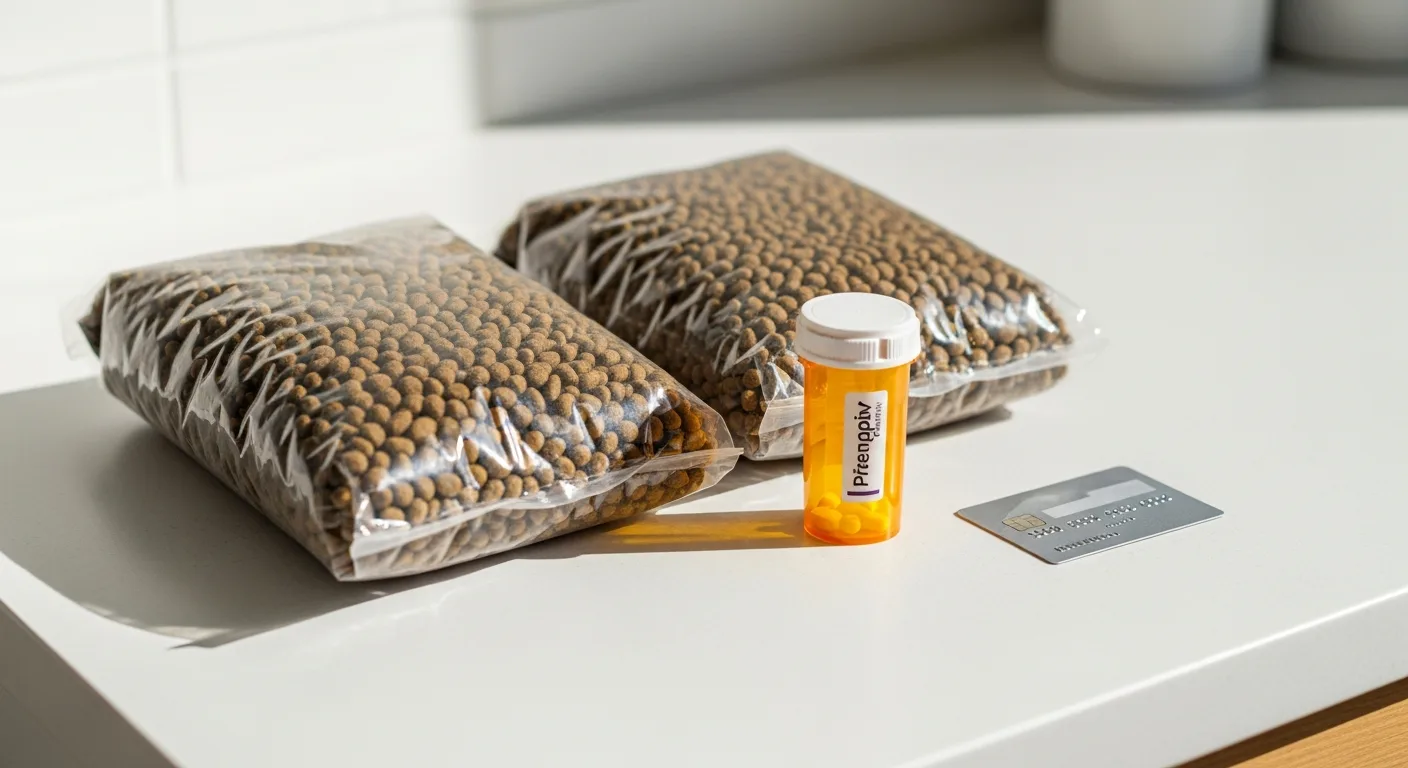
Pet food, meds, and supplies span multiple merchant categories — a flat-rate card earns on all of them.
Should You Get a Card With an Annual Fee?
Premium rewards cards often carry annual fees and offer higher earn rates or travel perks. The math question is simple: does the extra cash back cover the fee?
On $1,500 in annual pet spending, the difference between a 2% no annual fee card and a 3% card with an annual fee is modest. If that fee is high, you're behind on pet spending alone. If your total card spending is much higher and the fee card rewards all of it at a better rate, the fee can pay for itself. But you should do that math on your full spending, not just pet costs.
For most pet owners who want a dedicated or primary card for animal-related expenses, a no annual fee card is the cleaner call. Every cent of rewards is pure gain, and you're not locked into justifying the card year after year.
- Add up your total annual pet spending before picking a tier — vet, food, supplies, boarding, grooming, and meds.
- Subtract the annual fee from projected rewards to find your true net return.
- If the net return on a fee card beats a no annual fee card by less than $20–$30, no annual fee card is probably the smarter, lower-risk choice.
Cash Back Offers
Ready to earn cash back on every vet visit and bag of food?
What About a 0% intro APR Card for a Big Vet Bill?
Emergency vet bills can run into thousands of dollars — a surgery, a cancer diagnosis, or a serious injury. In those situations, a card with a 0% intro APR can act as an interest-free short-term loan, giving you time to pay off the balance without accruing interest charges.
This is a legitimate strategy, but it comes with one hard rule: you must pay the full balance before the 0% intro APR period ends. Once it expires, the ongoing interest rate kicks in on whatever remains — and those rates tend to be high. If you can't confidently pay off the bill within the promotional window, this approach could cost more than it saves.
Also worth knowing: these cards are recommended for good to excellent credit. If your credit profile isn't there yet, a card with a shorter promotional period may be more realistic. A flat-rate cash back card that you pay in full each month is a safer long-term strategy for managing pet costs without interest risk.
One more non-obvious point: if you're already carrying a balance on a rewards card, you're likely paying more in interest than you're earning in rewards. Rewards cards are only profitable when you pay the full statement balance every month.
A true 0% intro APR card charges zero interest if you pay the balance in full by the end of the promotional period. A deferred-interest plan (common with store financing) charges all the back-interest from day one if any balance remains at the end. They look similar but work very differently — always confirm which type you're signing up for.
How to Pick the Right Card for Your Pet Budget
Start with your actual numbers. Look at 12 months of pet-related transactions and sort them by where the purchase happened: vet clinic, grocery store, pet specialty retailer, online, or local service. That breakdown tells you whether a flat rate or a category card wins.
Then consider the full picture of your card use. If this card will be your everyday card — not just a pet card — then a high flat rate or a generous rotating bonus structure gives you more total value. If you're opening it specifically to capture pet spending, simplicity wins: a straightforward no annual fee card earning 1.5%–2% everywhere keeps things clean and profitable.
Sign-up bonuses are worth factoring in too. Many no annual fee cash back cards offer a welcome bonus after you hit a minimum spend in the first few months. If your pet spending alone can hit that threshold — say, a big vet visit or a year's worth of supplies front-loaded — you can earn a lump-sum boost on top of your ongoing rewards. Total US pet industry spending hit $152 billion in 2024, which shows just how real these budgets are.[1] That money is going somewhere — it might as well be earning rewards.[4]
- Mostly grocery store pet food? Look for a card with an elevated grocery category rate.
- Split between online retailers and vet visits? A flat-rate card is likely your best earner.
- Planning a large one-time vet expense? A 0% intro APR card could help you spread the cost interest-free.
- Spending under $500 a year on pets? Keep it simple — a no annual fee flat-rate card, and focus on using the same card for all your spending.
Compare Current Offers
Find a rewards card that works for your pet budget
Whether you want a simple flat rate or a card that rewards specific categories, there are solid options available now. Compare current offers to see what fits your spending.

Checking which merchant categories your pet spending falls into takes ten minutes and can meaningfully change your card choice.
Learn More About Top OffersFrequently Asked Questions
What type of rewards card works best for pet expenses?
Can I earn bonus rewards on vet bills specifically?
Is a no annual fee card better than one with an annual fee for pet expenses?
Is it worth opening a separate card just for pet spending?
What credit range are rewards cards typically recommended for?
How do I know if my pet food store earns bonus rewards?
Does using a rewards card for pet care affect my credit score?
The Bottom Line
For most pet owners, a no annual fee flat-rate cash back card is the right call. Pet spending is too fragmented across vet clinics, grocery stores, online retailers, and service providers for any single bonus category to capture cleanly. A card earning 1.5%–2% on everything earns reliably, costs nothing to hold, and requires zero mental overhead.
The exception: if your vet bills are predictably large and you can pay off a balance within a promotional window, a card with a 0% intro APR period could help you manage a big expense without interest charges. Whatever you choose, pay the statement balance in full each month — the moment interest charges start, they'll outrun any rewards you've earned.