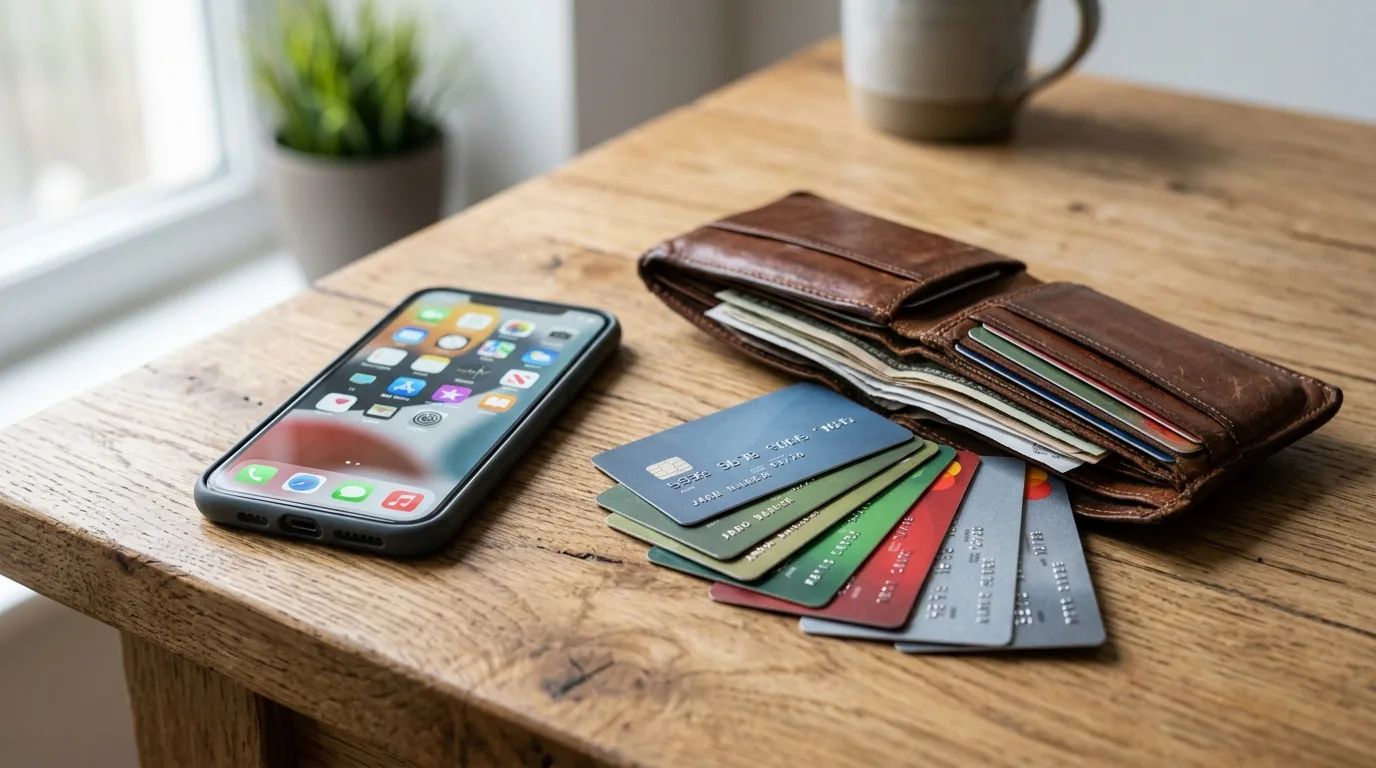
No, you probably don't need a fifth card just for Spotify and Hulu. The myth worth busting here is that every spending category deserves its own dedicated card. That mindset works fine when the category is big, like groceries or gas, but streaming subscriptions are usually small, fixed, and predictable — which is exactly the kind of spending your everyday or general cash back card was built to soak up without any extra effort.
Key Takeaways
- Streaming subscriptions are small and fixed, so a dedicated card rarely earns enough extra to offset the hassle of managing another account.
- Your existing everyday or flat-rate cash back card likely already covers Spotify and Hulu at a competitive rate with zero setup.
- More cards mean more due dates, and with nearly half of cardholders carrying a balance at some point, added complexity carries real risk.[4]
Why does a streaming card sound appealing in the first place?
It feels organized. You've got a warehouse card for bulk shopping, a store card for online shopping, a gas card at the pump, and a general card for everything else. Adding a fifth card that boosts streaming subscriptions seems like the natural next step in building the “perfect” wallet. compare current cash back offers
But categorization for its own sake isn't the goal—earning more, or spending less effort, is. Streaming is different from groceries or gas because the dollar amount usually changes little from month to month. You're not optimizing a variable, growing expense. You're optimizing a couple of subscription charges that may represent only a modest part of your monthly spending.
Already know what you want? Four cards already covering the essentials — does a fifth card for streaming actually move the needle?
Learn MoreWhat does the math actually look like?
Say your streaming subscriptions add up to a modest monthly amount. If your current everyday card already earns a flat rate on general purchases, that's some cash back from streaming. A dedicated streaming card might offer a higher rate, but the annual difference may be small.
Nine dollars a year is real money, but it's not much once you factor in the cost of attention: a new application, a new login, a new due date, and a new card sitting in your wallet mostly unused outside two subscription charges. For most people, the everyday card already in rotation makes more sense to keep pointed at streaming.
The math changes if you're someone who pays for several streaming services and other subscription-style charges, such as software, cloud storage, or a gym app. U.S. consumers report paying an average of $69 per month for four paid streaming-video services combined, suggesting that Spotify and Hulu alone may represent only a modest share of a typical household’s subscription spending.[1] At that volume, a boosted category rate is worth a second look.
Add up every recurring subscription you'd actually route to a new card, not just Spotify and Hulu. If the combined monthly total is modest, the earnings gap from a specialty card may be too small to justify opening one.

Adding up all recurring subscriptions, not just two, gives a clearer picture of whether a dedicated card is worth it.
What's the hidden cost of a fifth card?
U.S. consumers have an average of 3.7 credit cards that they regularly use, providing context for evaluating whether another account adds meaningful value to an already crowded wallet.[3] Adding another card means one more statement to check, one more due date to track, and one more login to remember—for a category that's already small and, frankly, unstable.
That instability matters more than people expect. Streaming isn't a fixed expense the way rent or a car payment is. Thirty-nine percent of surveyed U.S. consumers said they had canceled at least one paid streaming-video service during the previous six months, indicating that streaming charges can change frequently rather than remain stable recurring expenses.[2] If you cancel one service or swap it for a different one, the card you opened specifically for it starts to earn its normal, unremarkable rate on whatever you replace it with—assuming that new service even earns the bonus category at all.
There's also the account-management risk. Among U.S. adults with a credit card, 46% reported carrying an unpaid balance at least once during the prior year, underscoring the importance of account-management and debt risks when adding another card for a small recurring purchase category.[4] More open accounts generally means more chances to miss a payment, misjudge a due date, or lose track of a small balance that quietly accrues interest—costing you far more than the few extra dollars a streaming bonus rate would earn.
Cash Back Offers
Still curious what a dedicated card would earn you?
| Approach | Annual earnings on streaming spend | Extra accounts to manage |
|---|---|---|
| Keep using an existing everyday card | Cash back at the card's existing rate | 0 |
| Open a dedicated streaming card with a higher rate | Cash back at the card's higher rate | 1 more due date, login, and application |
When does a dedicated streaming card actually make sense?
It's not never. If your household runs a genuinely large subscription stack—several streaming services, a music service, cloud storage, a meal-kit app, and paid newsletters—a card that rewards digital subscriptions at a meaningfully higher rate starts to pencil out.
It also makes sense if you're specifically trying to diversify issuers for credit-mix reasons, or if the card in question has no annual fee and you'd genuinely use it as a backup without letting it go dormant. A dormant card isn't dangerous, but it is one more login you don't need.
- Combined recurring subscription spend is consistently substantial
- The card has no annual fee, so an underused account costs you nothing to hold
- You're confident you'll pay the statement in full every month regardless of which card you use
- You want a backup card for reasons unrelated to streaming, and the bonus category is a nice bonus, not the main reason
What should you do instead?
Before opening anything new, look at the four cards you already carry. Is your 'everyday purchases' card actually your best flat-rate earner, or is it just the one you defaulted to years ago? If you're going to spend energy optimizing, spend it there first — you might find you can bump your streaming earnings simply by switching which existing card you point at those two subscriptions.
If after that review you still want to explore a subscription-focused card, you can compare current cash back offers to see which ones reward digital or app-based purchases without an annual fee, so a lightly used card doesn't cost you anything to keep.
Compare Current Offers
Ready to simplify instead of adding another card?
See how today's flat-rate and everyday cash back cards stack up before you open anything new.

Reviewing your existing cards' rewards rates often reveals savings without opening anything new.
Learn More About Top OffersFrequently Asked Questions
Should I get a separate cash back card just for Spotify and Hulu?
How much would a streaming-only card actually earn me?
What should I do instead of opening a new card?
Does having five credit cards hurt my credit score?
Will canceling a streaming service leave me with a useless card?
Is it better to consolidate spending onto fewer cards?
What if I have a lot of other subscriptions beyond Spotify and Hulu?
The Bottom Line
A card dedicated to streaming subscriptions is a solution looking for a problem that mostly doesn't exist. The spending is often too small and too fixed to generate meaningful extra earnings once you weigh it against another account to manage. Your energy is better spent making sure the cards you already carry are pulling their weight.
If your subscription stack grows well beyond two services, revisit the math — at that point a subscription-focused card with no annual fee could genuinely help. Until then, compare current cash back offers mainly to benchmark your existing cards, not to add a fifth one.