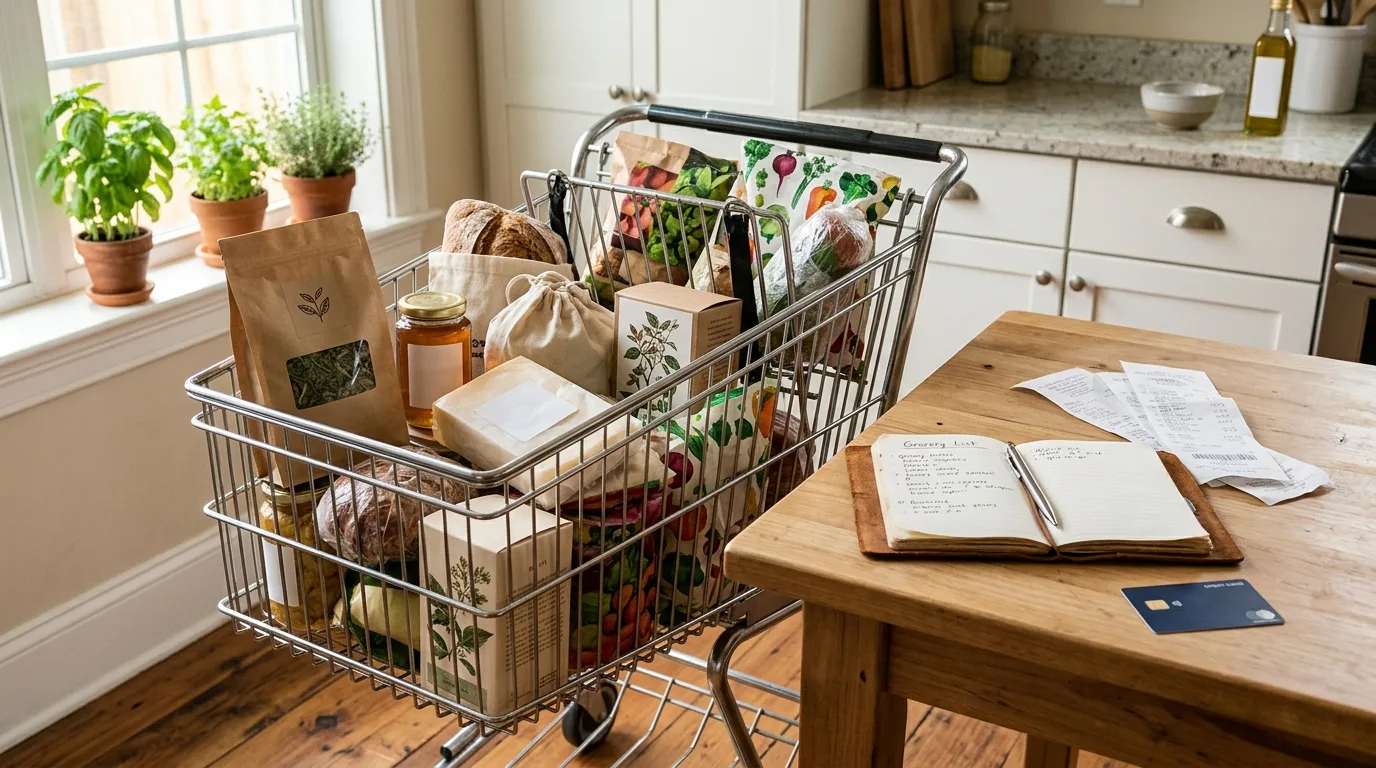
Pick the card that pays you the most on the store you actually shop at, not the one with the biggest advertised grocery rate. For a family of four with dietary restrictions, that's often a specialty grocer or a warehouse club rather than a standard supermarket, and that distinction changes which card actually wins.
Key Takeaways
- A high grocery cash back rate only pays off if it applies to the specific stores your family can actually shop at.
- Dietary restrictions often push families toward specialty grocers or multiple stores, which can shrink or void a card's grocery bonus category.
- Run your real 12-month grocery total through both a category card and a flat-rate card before deciding — the math isn't always obvious.
Why grocery spending hits differently for your household
The average U.S. household spent a bit over $6,200 on food at home in 2024, which came out to roughly 8% of total spending.[1] For a family of four managing dietary restrictions — say, one kid with a dairy allergy and a parent who needs gluten-free staples — that number is often higher, because specialty products cost more and you can't always buy the cheapest version on the shelf. compare current grocery cash back offers
Food allergies alone affect a meaningful share of households: about 7% of adults and 5% of kids have a diagnosed allergy.[2] That's not a rare situation. It means a large number of families are, like yours, navigating a grocery budget that's both bigger and less flexible than the typical household's.
That inflexibility is the part most credit card advice misses. A card that pays great cash back 'at supermarkets' is only valuable if the store carrying your family's safe foods actually codes as a supermarket. Specialty health-food stores, butcher shops, co-ops, and some warehouse clubs often don't.
Already know what you want? Groceries are the biggest line in your budget and dietary needs limit where you can shop — here's how to find the card that actually pays you back for that reality.
Learn MoreGrocery-category card vs. flat-rate card: the real tradeoff
A grocery-category card typically pays an elevated rate at supermarkets, often up front on the first several thousand dollars spent each year, then drops to a lower rate after that cap. If your family spends close to the national average, say around $500 a month at one main grocery store, that card can earn noticeably more than a flat-rate option — as long as that store qualifies.
A flat-rate card pays the same percentage on every purchase, period. No store-code gymnastics required. If you split your $500 monthly grocery budget between a regular supermarket and a specialty store for allergy-friendly items, the flat-rate card captures 100% of that spending at one consistent rate. The category card might only capture the supermarket half.
Here's the part worth sitting with: many households already shop at more than one store out of necessity, not preference. USDA data on grocery habits found that among households with an identified primary and alternate store, about a quarter visited both in a single week, and roughly half visited at least one of the two.[3] If that's your pattern, a single-store bonus category is working against you before you've even swiped the card.
Take your last three months of grocery receipts and sort them by store. If more than a third of your spending happens outside the store type your card bonuses, a flat-rate card is probably earning you more in practice than the category card's higher rate on paper.

Splitting purchases across stores is common — and it can work against a single-category card.
Cash Back Offers
See which grocery cash back card fits your shopping pattern
How dietary restrictions change the shopping math
Consumers say price drives about three-quarters of food purchase decisions, healthfulness drives well over half, and convenience factors into more than half as well.[4] When a dietary restriction is in play, those three pressures pull in different directions — the cheapest store might not carry what your family needs, and the most convenient one might charge a premium for allergy-friendly brands.
That tension is exactly why store flexibility matters more than a flashy percentage. If your family's safe foods are only reliably stocked at a specialty grocer or ordered online through a delivery service, check whether your card's grocery category actually includes those merchant types. Many categories explicitly exclude large general retailers, club stores, and some delivery platforms even though you'd call them 'the grocery store' in conversation.
If your household order is split — a weekly staples run plus a separate trip or online order for specialty items — consider running the specialty portion through a flat-rate card and the staples run through a grocery-category card. Two cards used deliberately can out-earn one card used everywhere.
- Check if your main specialty or health-food store is coded as a 'supermarket' by the card issuer — call and ask if unclear.
- Confirm whether online grocery or delivery orders qualify for the bonus category, since many cards treat them differently than in-store purchases.
- Check for an annual spending cap on the bonus category; spending past it drops you to the base rate for the rest of the year.
- Factor in annual fees on category cards — recommended for good to excellent credit — against the extra cash back you'd actually realize.
A simple way to decide which card fits your family
Pull your last 3-6 months of grocery spending and separate it into two buckets: purchases at a single main store, and everything else (specialty shops, co-ops, online orders, a second supermarket). If one bucket clearly dominates, lean toward the card type that rewards it — category card for a concentrated main-store pattern, flat-rate for a split pattern.
Next, estimate the dollar difference between the two card types using your real numbers, not the national average. A family spending close to $700 a month will see a bigger gap between card types than one spending $300, simply because percentages compound on larger totals.
Finally, weigh convenience. If tracking two cards and remembering which one to use at which store feels like one more chore in an already complicated shopping routine, the simpler flat-rate option may be worth a slightly lower ceiling on earnings. Simplicity has value too, even if it doesn't show up on a rewards statement.
Imagine $500 a month split as $350 at a main supermarket and $150 at a specialty grocer. A grocery-category card's higher rate applies only to the $350. A flat-rate card's lower rate applies to the full $500. Do that math with your own numbers before assuming the category card wins.
Compare Current Offers
Ready to put your grocery spend to work?
Compare today's top cash back cards side by side and find the one that matches where your family actually shops.

Matching card type to shopping pattern takes a few minutes of comparing statements.
Learn More About Top OffersFrequently Asked Questions
What's the best type of cash back card for heavy grocery spending?
Does a dietary restriction change which grocery card makes sense?
Should I get two cards instead of just one?
Do grocery category bonuses have a spending cap?
Does ordering groceries online count toward a grocery bonus category?
Are warehouse club purchases counted as groceries?
Is it worth paying an annual fee for a grocery cash back card?
The Bottom Line
When groceries dominate your budget, the instinct is to chase the highest advertised cash back percentage. But for a family navigating dietary restrictions, the store you shop at matters as much as the rate itself. A grocery-category card only pays its best rate where it recognizes the purchase as groceries, and specialty stores, co-ops, and some delivery services don't always qualify.
Pull your real spending data, split it by store type, and run the numbers both ways before choosing. For many families with split shopping patterns, a flat-rate card could end up earning more in practice than a flashier category card.