If you have a payoff plan before the promotional period ends, opening a new card just to finance a ring can be a smart move. The real question isn't whether to use a credit card; it's whether to open a new one that lets you split the cost over a year or more without paying interest, or to put the charge on a rewards card you already own and collect points on a big spend. For most people buying a ring in the $3,000–$6,000 range, the right answer is: do both.
Key Takeaways
- A 0% intro APR card lets you spread a ring purchase over a year or more with no interest — but you must pay the full balance before the promotional period ends or you'll face the card's standard variable APR.
- Opening a new card for the ring can also trigger a welcome bonus, effectively earning you cash back or travel points on top of the interest-free financing.
- Carrying a balance past the intro period on a card with a high standard variable APR can cost hundreds of dollars in interest — so a realistic payoff plan is non-negotiable before you charge anything.
The Story Behind the Strategy
Picture this: you've found the ring. It's $4,500. You have the cash — but it's sitting in a savings account earning a little interest, and you'd rather not drain it in one shot. Or maybe you don't have the full amount yet, and you need a few months to get there. Compare current 0% intro APR offers.
Putting $4,500 on a card with a 20% standard variable APR and carrying even part of that balance for six months would cost you somewhere north of $200 in interest charges. The average interest rate on credit card plans was 20.94% as of May 2026.[1] That's a real cost — roughly the price of a nice dinner for two, every single month you carry a balance.
The smarter play: compare current offers for a card with a long 0% intro APR period — typically 12 to 21 months depending on the card — before you walk into the jeweler. You charge the ring, pay it off in equal monthly chunks, and owe no interest. If the card also carries a welcome bonus with a spending threshold you'd hit anyway, you walk away with free travel miles or cash back on top.
Already know what you want? An engagement ring is one of the biggest single purchases most people make. A 0% intro APR card can turn it into an interest-free installment plan — and may even reward you for the spend. Here's how to pick the right card and use it without it costing you more than the ring itself.
Learn More0% intro APR vs. Rewards: Which Matters More for a Ring?
Most people frame this as an either/or choice. It doesn't have to be.
If you're carrying no other high-interest debt and you need 12-plus months to pay off the ring, the 0% intro APR is the dominant priority. Here's why: the interest you avoid on a $4,500 balance over a year at a standard variable APR can easily outweigh 1.5%–2% cash back on the same purchase. The math isn't close.
But many cards that offer a 0% intro APR period also offer a welcome bonus — spend a certain amount in the first few months, earn a chunk of cash back or points. Since you're making a large purchase anyway, you'd hit that threshold with the ring alone. That means you can get the interest-free financing AND the bonus in one move.
The one trap to avoid: research shows that rewards and welcome offers dominate how cards are marketed, appearing on the front page of offers over 94% of the time — while APRs appear on just 28% of front pages.[3] Don't let a flashy bonus distract you from confirming the intro APR period is long enough for your actual payoff plan.
Look for a card that offers both a 0% intro APR period AND a welcome bonus with a minimum spend you'll clear just by buying the ring. You get interest-free financing and a reward — no extra spending required.

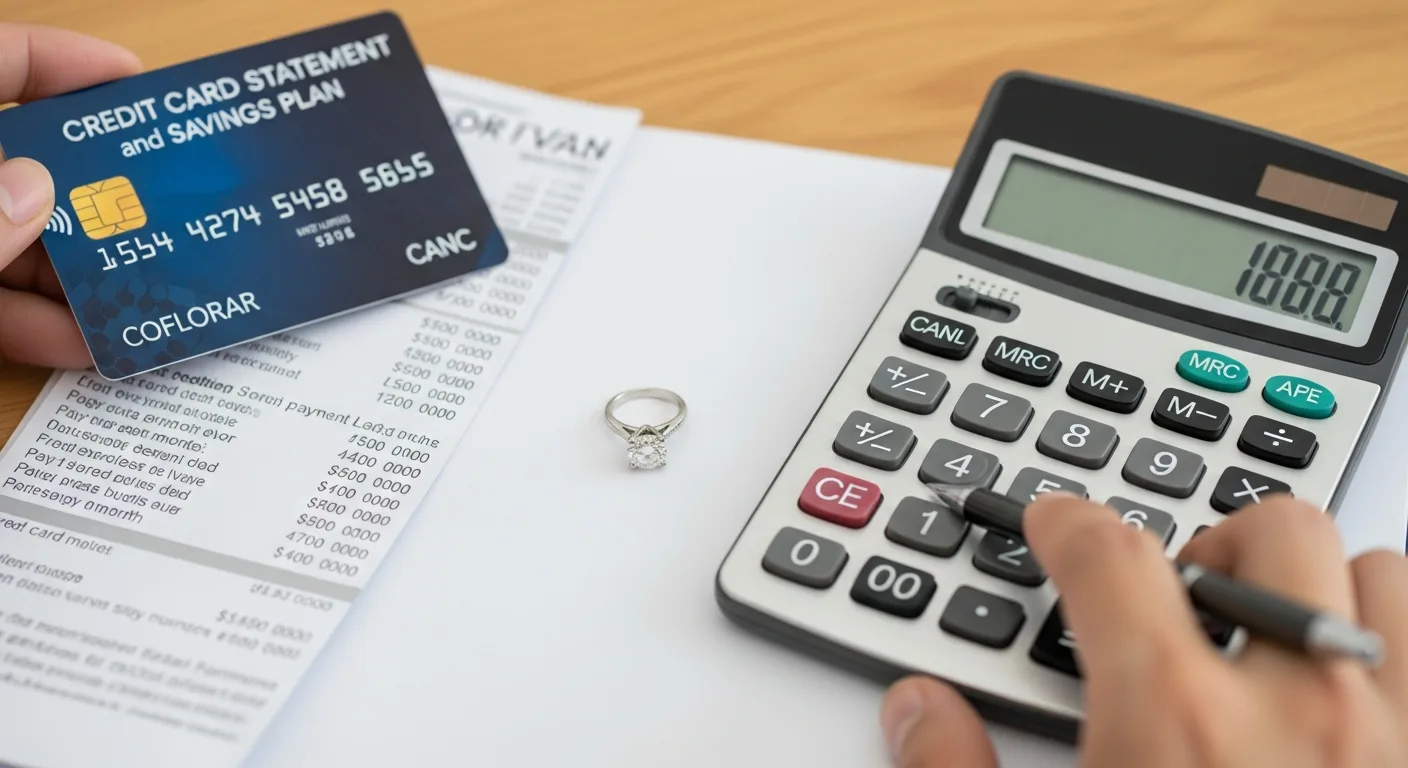
Mapping out monthly payments before you buy keeps the interest-free window working in your favor.
How to Build Your Payoff Plan Before You Apply
The 0% intro APR is only free if you use it correctly. If you carry a balance past the promotional period, the remaining amount starts accruing interest at the card's standard variable APR — which, again, is above 20% for most cards right now.[1]
Here's the simple framework using our $4,500 ring as the example. If the intro period is 15 months, divide $4,500 by 15. That's $300 per month — your self-imposed minimum. Set it as an auto-payment so you never miss it. If something changes and you can pay more in a given month, great. But $300/month gets you to zero before interest ever touches the balance.
The danger zone is treating the intro period like a grace period with no urgency. Cardholders who revolve debt from one cycle to the next pay 94% of all credit card interest and fees, while receiving less than 30% of rewards benefits.[4] Put plainly: if you're carrying a balance, the card is almost certainly costing you more than it's rewarding you.
One non-obvious timing tip: compare current offers a few weeks before you shop, not the day of. Your credit score takes a small temporary dip from the hard inquiry. Giving it a few weeks to settle means you're not walking into the jeweler with a freshly dinged score on your mind — and your new card will already be in hand, ready to use.
- Divide the ring price by the number of months in the intro period — that's your monthly payment target.
- Set up auto-pay for that exact amount the day your card arrives.
- Apply a few weeks before you shop so the inquiry settles and your card is ready.
- Never make only the card's stated minimum payment — it won't zero out the balance in time.
- Keep a note in your calendar two months before the intro period ends as a final check-in.
0% Intro APR Offers
Ready to Find the Right Card for Your Ring?
What Type of Card Should You Actually Look For?
There are two main card types that fit this situation, and they suit different financial pictures.
no annual fee card with a 0% intro APR is the cleanest choice if you want zero ongoing cost and straightforward financing. These are recommended for good to excellent credit. The intro period tends to range from 12 to 21 months. Some earn a modest flat-rate cash back on every purchase, which means you'd passively collect a small return on the ring charge without any category tracking.
An annual fee card with a richer rewards structure can make sense if you'd already planned to open that card — or if the welcome bonus is large enough to offset the fee after the ring spend triggers it. But don't open an annual fee card just for the ring if you won't use it long-term. The fee erodes your savings.
One more option worth knowing about: some jewelers offer in-store financing. Always compare that offer against a general-purpose 0% intro APR card. In-store financing sometimes uses deferred interest — meaning if you don't pay the full balance before the promotional period ends, you're charged interest retroactively on the original amount, all the way back to day one. A true 0% intro APR card only charges interest on whatever balance remains after the period ends, not the full original purchase. That difference can be enormous.
In-store jewelry financing often uses deferred interest, not a true 0% intro APR. If you miss the payoff window by even one month, you could owe interest on the full original price — not just what's left. A general-purpose 0% intro APR card is usually the safer structure.
Does Opening a New Card Hurt Your Credit Score?
A little, and temporarily. Applying for a new card triggers a hard inquiry, which typically trims a few points from your score. Opening the account also lowers your average account age, another small factor. Both effects fade within a few months.
On the positive side, the new card increases your total available credit. If you're not maxing it out, your overall credit utilization — the percentage of your total credit limit you're using — actually improves. A $4,500 charge on a card with a $10,000 limit puts you at 45% utilization on that card, which is higher than ideal. If your other cards are low, your overall utilization might still stay reasonable. Pay the ring down quickly and the utilization issue resolves itself.
Bottom line on credit: if you're planning to apply for a mortgage or car loan in the next three to six months, timing matters. Opening a new card right before a major loan application isn't ideal. If your next big financial move is a year or more out, the short-term credit dip is essentially irrelevant.
The One Scenario Where You Should Skip the New Card
If you already carry balances on other cards, opening a new 0% intro APR card for the ring is still fine — but only if you actually commit to a strict payoff schedule on the ring and don't use the new card as a reason to slow down payments elsewhere.
The real risk: people open a new card, charge the ring, and unconsciously relax on their other debt because they feel like they 'have a plan.' Then the intro period ends, the ring balance isn't fully paid, and they're juggling high-interest debt on multiple cards. That's the scenario the statistics above are warning against.
If your existing debt load is significant, consider whether paying down what you have is a better use of cash flow than splitting it across a new ring payoff plan. Sometimes the right answer is to save a little longer and buy the ring with cash — or to put it on an existing rewards card you'll pay in full immediately.
Compare Current Offers
Compare Cards Before You Buy the Ring
The best time to compare current offers is a few weeks before you shop, so your card is in hand and your credit inquiry is behind you. Compare current offers to find the intro period length and rewards structure that fits your payoff timeline.
Timing your application and payoff schedule before shopping is the move most buyers skip.
Learn More About Top OffersFrequently Asked Questions
Is it smart to open a new credit card just to buy an engagement ring?
What happens if I don't pay off the ring before the 0% intro APR ends?
Should I prioritize rewards or a 0% intro APR for this purchase?
How many months of intro APR do I need for a $4,500 ring?
Is jeweler financing better than a credit card 0% intro APR offer?
Will opening a new card for the ring hurt my credit score?
Can I earn a sign-up bonus and still get the 0% intro APR?
The Bottom Line
For most people buying an engagement ring, the best move is to open a no annual fee card with a long 0% intro APR period — ideally one that also triggers a welcome bonus with the ring purchase. Divide the price by the number of months in the intro window, auto-pay that amount every month, and the ring costs you exactly what you paid at the counter. Not a dollar more.
The only way this goes wrong is if you don't have a payoff plan before you apply. Do the math first, pick a card whose intro period matches your timeline, and compare current 0% intro APR offers before you walk into the jeweler. The ring should be the memorable part — not the interest bill.