
A reimbursed commute can be a smart way to earn cash back, but the best card depends on whether your spending is mostly gas, parking, transit, or tolls. Because your employer pays you back, rewards you earn on that spending can be a nice extra — and the main question is whether a category card or a flat-rate card fits your commute best.
Key Takeaways
- A reimbursed commute is effectively spend with zero net cost to you — making rewards earned on it pure profit.
- The right card structure depends on how you commute: drivers should prioritize gas and parking categories, transit riders should look for transit or flat-rate cards.
- no annual fee card is almost always the right call here, since the fee would eat directly into the rewards you're trying to earn.
Why a Reimbursed Commute Is a Hidden Cash Back Gold Mine
Most people think of rewards cards as a way to get a little something back on everyday spending. A reimbursed commute flips that math entirely. When your employer covers the bill, your net cost is zero — and any cash back you earn on top is pure gain. compare current cash back offers
Transportation is not a small spending category. U.S. households spent an average of $13,318 on transportation in 2024, equal to 17.0% of total consumer-unit spending.[2] Even if your employer only reimburses commute costs and not all transportation, the recurring monthly charges — gas fills, monthly parking, tolls, transit passes — add up fast.
The key insight most people miss: you are effectively an interest-free lender to your employer for a week or two every month. A cash back card means you get paid a small fee for that loan. Do that every month for a year and you have a meaningful stack of cash that required zero extra behavior from you.
Note how many days pass between when you charge commute costs and when your employer reimburses you. As long as you pay your statement balance in full by the due date, you owe zero interest — and you keep every cent of cash back earned.
Already know what you want? Your employer is about to hand you back every dollar you spend on getting to work. The cash back you earn in the meantime? That's yours. Here's how to make sure you're capturing it.
Learn MoreWhat Does Your Commute Actually Look Like?
Before picking a card, map out where your commute dollars actually go. In 2024, 69.2% of U.S. workers drove alone to work.[1] If you're in that group, your biggest spend categories are likely gas stations and parking. If you're on transit, you're looking at monthly passes or per-trip charges that may or may not code as a distinct category on a credit card.
Take a hypothetical: say your employer reimburses $300 a month in commute costs — $150 in gas, $100 in monthly parking, and $50 in tolls. On a flat-rate card earning 2% back, that's $6 a month or $72 a year. On a card earning 3% at gas stations and 3% on transit and commuting, the same $300 could return $9 a month or $108 a year. Neither figure is life-changing, but the category card earns 50% more for the same zero effort.
Tolls are the trickiest piece. Automated toll payments often charge to a linked account or a prepaid transponder rather than directly to a credit card. If your tolls are paid through a transponder auto-reload, check whether your card lets you set that reload to charge to a credit card — some do, and the gas or travel category may apply.
- Gas-heavy commute: prioritize a card with elevated cash back at gas stations (often 3–5%)
- Parking-heavy commute: look for cards that include parking garages in their transit or travel category
- Transit commute: some cards offer a dedicated transit category covering buses, subways, and ride-shares
- Mixed commute: a flat-rate card with 2% or more on everything avoids the category-matching headache

Mapping out your commute costs by category — gas, parking, tolls, transit — takes ten minutes and tells you exactly which card structure wins.
Category Card vs. Flat-Rate Card: Which Wins for Commuters?
Category cards offer higher earn rates on specific spending types — gas, transit, dining — and lower rates (sometimes just 1%) on everything else. Flat-rate cards earn the same percentage on every purchase. For a commuter whose reimbursed spend is concentrated in one or two categories, a category card almost always wins on the commute itself.
But here's the non-obvious catch: if you put other spending on the same card — groceries, streaming, online shopping — a category card may shortchange you on those purchases unless they happen to hit a bonus category too. That's why some commuters end up with a dedicated card just for commute expenses, and a separate flat-rate card for everything else. Two cards, both no annual fee, each doing one job well.
Using the $300-a-month example: if your card earns 3% on gas and 1% on everything else, and you also run $1,000 in non-commute spending through it, you'd earn $9 on commute plus $10 on other spend — $19 total. A 2% flat-rate card on the same $1,300 earns $26. The flat-rate card wins overall even though it loses on commute alone. The math shifts back in the category card's favor only when you separate commute from everyday spend.
The bottom line: a single-purpose commute card usually wants a category card. A do-everything card usually wants flat-rate.
Consider keeping a dedicated card purely for reimbursed commute charges. It makes expense tracking clean for your employer and keeps your rewards calculations simple. No annual fee means no drag on the math.
Cash Back Offers
Ready to Start Earning on Every Commute?
Does an Annual Fee Ever Make Sense Here?
Almost never — and here's exactly why. An annual fee needs to be justified by the rewards and perks it unlocks. On a commute-focused card, your eligible spend is capped by how much your employer actually reimburses. If that's $300 a month, even a generous 3% earn rate gives you $108 a year. An annual fee would wipe out most of your earnings. You'd be working your commute all year for not much reward.
The exception is if the card also bundles perks you'd genuinely use regardless of the commute — purchase protection on personal spending, an annual travel credit that offsets the fee, or strong flat-rate rewards on grocery and dining spend. In that scenario, the commute rewards become one piece of a larger value picture. But that's a different card evaluation. For a card whose primary job is capturing reimbursed commute cash back, no annual fee card is the right frame.
One more thing to check: the IRS sets monthly exclusions for employer-provided commuter benefits — for 2026, that limit is $340 per month for qualified parking and $340 for commuter highway vehicle transportation and transit passes.[3] If your reimbursement stays at or under those thresholds, there's typically no tax complication for you. Above those thresholds, the excess may be treated as taxable income — worth a quick check with your employer's HR or benefits team.
What About the Cost of the Commute Itself?
Cash back is real money, but it's worth keeping it in perspective against the total cost of commuting. The average cost of owning and operating a new vehicle was $0.82 per mile in 2024, assuming 15,000 miles per year.[4] If your employer only reimburses some of that — say, gas and tolls but not depreciation or maintenance — the reimbursed portion is smaller than the true cost of getting to work.
This isn't a reason to skip the cash back card. It's a reason to be realistic about what it solves. A card earning $100 a year in commute rewards is a genuine win. It doesn't transform the economics of your commute, but it's money you would otherwise leave on the table for zero additional effort.
The smarter play is to treat commute cash back as a small, automatic, recurring bonus — not a financial strategy. Pick the right card structure once, set it up, and let it run. That's where the real value lives: in the consistency, not the size of any single month's return.
How to Choose: A Simple Decision Framework
Start by adding up your average monthly reimbursed commute costs and breaking them down by type: gas, parking, transit passes, tolls, ride-shares. That breakdown tells you whether your spend is concentrated enough to justify a category card or scattered enough that flat-rate wins.
Next, decide whether this card will be commute-only or general-use. Commute-only points you toward the best category rates with no annual fee. General-use points you toward the strongest flat-rate option with no annual fee, and you evaluate commute categories as a secondary factor.
Finally, check the card's merchant category codes for your specific commute types. Gas stations are almost universally recognized as a category. Parking garages and transit can vary — some cards include them under a broad commuting or transit umbrella, others don't. A quick look at a card's category definitions before applying saves frustration later.
- Add up your monthly reimbursed commute spend and break it down by category
- Decide: dedicated commute card or general-use card?
- Match card type: category card for concentrated spend, flat-rate for mixed spend
- Verify the card treats your specific commute costs (parking, tolls, transit) as bonus categories
- Confirm no annual fee so every dollar of rewards is pure gain
- Check the reimbursement timing and make sure you can always pay the balance in full before the due date
Compare Current Offers
Turn Your Commute Into Monthly Cash Back
no annual fee cash back card matched to your commute type could put real money back in your pocket every month — on spending your employer is already covering. Check out top offers available now.
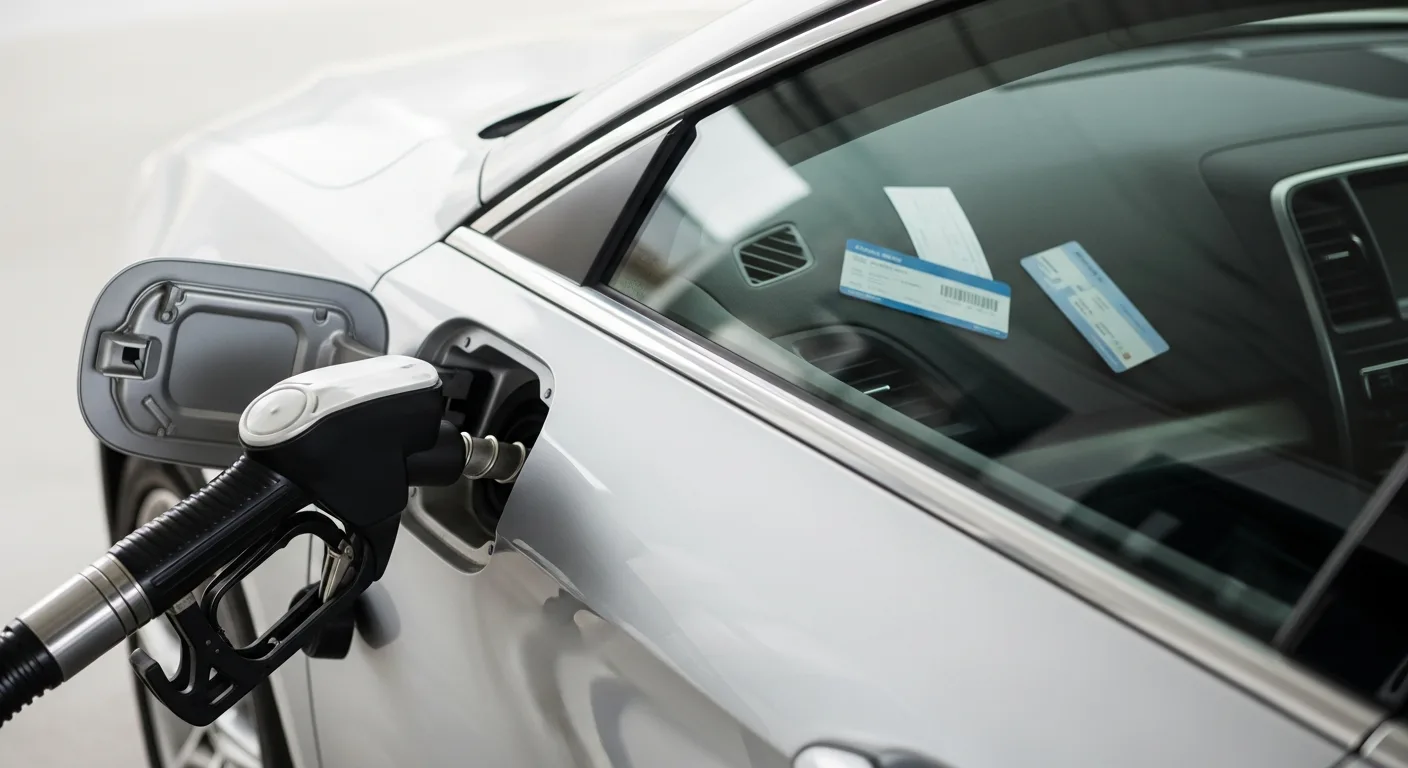
Gas, parking, and transit are all potentially bonus categories — but the right card depends on which costs dominate your commute.
Learn More About Top OffersFrequently Asked Questions
Is a reimbursed commute a good way to earn cash back?
Should I get a category card or a flat-rate card for commuting?
Does an annual fee make sense for a commute cash back card?
Do tolls earn cash back on a credit card?
What if my employer pays my transit pass directly — can I still earn rewards?
Is it worth getting a separate card just for commute expenses?
Does earning cash back on reimbursed expenses create a tax issue?
The Bottom Line
A reimbursed commute is a straightforward opportunity: real recurring spend, zero net cost to you, and rewards that are yours to keep. The right card structure is almost always no annual fee card matched to your commute type — category card if your spend is concentrated in gas or parking, flat-rate if it's spread across multiple commute costs.
Set it up once, pay the balance in full every month, and let the rewards accumulate automatically. It won't replace your salary, but it's one of the few financial wins that genuinely requires nothing extra from you. Compare current cash back offers to find the structure that fits your commute.